2026-06-13
Retrieval Deep Dive
Our Part 6 app works, but it retrieves naively: pure semantic search with a fixed top-k. Part 7 of a from-scratch series on Retrieval-Augmented Generation: why dense retrieval whiffs on exact codes and names, the sparse (keyword) retrieval that nails them, TF-IDF and BM25 explained by intuition, how hybrid search fuses the two (weighted sum and Reciprocal Rank Fusion), and why top-k is a real knob with a lost-in-the-middle trap. Dense and sparse fail in opposite directions; combine them.
What you’ll learn
In Part 6 we finally stopped explaining and built the thing: a complete, working RAG application that embeds a small knowledge base, embeds the user’s question, ranks chunks by cosine similarity, keeps the top few, and hands them to a language model. It works. It is also naive in one specific way we glossed over: it uses pure semantic search with a fixed top-k, and that quietly limits how good it can get. This part is about retrieval itself, the heart of RAG. You’ll learn why semantic search, for all its cleverness, can miss an exact term sitting in plain sight (a product code, an error code, a name); what sparse keyword retrieval is and why it catches exactly those cases; the two classic ways to combine them into hybrid search; and why top-k, which we treated as a constant, is actually a dial with a real trade-off and a surprising failure mode. By the end you’ll understand all three flavors of retrieval, when each shines and fails, and how to fuse them.
Prerequisites
Parts 1 through 6, and especially Embeddings, Truly Understood (Part 2), Measuring Similarity (Part 3), and Build Your First RAG (Part 6). You should be comfortable that text becomes a vector, that similar meanings sit close together, that we rank candidates by cosine similarity and keep the top-k, and that you have an end-to-end app doing exactly that. Basic Python helps for the one focused code addition, but this is mostly a concept chapter: we lead with intuition and pictures.
The miss that motivates everything
Let me show you our app failing, because the failure is the whole reason this chapter exists.
Our Part 6 knowledge base includes a short support article: “Error E-4042: the authentication token has expired. Refresh the token and retry the request.” A user types the most natural question in the world:
how do I fix error E-4042 at checkout?You would bet money the app returns that article. It does not. The top results come back as “Troubleshooting checkout and payment failures,” “Resolving login and authentication issues,” and “The checkout page shows a generic error after Pay.” All plausibly related. None of them is the article that literally answers the question. The chunk we needed sits down at rank five, below the fixed top-k cutoff, so the language model never sees it and answers with a vague guess.
What went wrong? Nothing was broken. The embedding model did its job: it found chunks that are about checkout errors and authentication, because that is what the query is about, semantically. But the single most informative token in the whole query, the exact code E-4042, carried almost no weight, because to an embedding model a rare alphanumeric code is nearly meaningless. Its meaning gets blurred into the surrounding topic. The model rounded off the very token we needed.
This is not a bug to patch. It is a structural limit of one kind of retrieval, and the cure is to understand the kinds. Our goal for this part: learn the flavors of retrieval, see exactly when each one shines and fails, and learn how to combine them so the failure above stops happening.
Dense (semantic) retrieval: recap and limits
Start with what we already built. Dense retrieval is the approach from Parts 2 and 3: embed the query and every chunk into vectors, then rank chunks by cosine similarity to the query. It is called dense because the vectors are short and packed, every one of their few hundred or thousand dimensions carries a real number, and meaning is spread across all of them at once.
Its strength is meaning. Because Part 2 turned text into geometry where similar ideas sit close together, dense retrieval understands synonyms and paraphrase for free. A query about an “automobile” finds a chunk about a “car” even though they share no letters, because the two words land near each other in the space. Ask for “ways to lower my monthly bill” and it can surface “reducing your recurring charges.” This is genuinely powerful, and it is why semantic search felt like magic when we first built it.
But the same property that makes dense retrieval strong makes it weak in a predictable place. Tie it back to Part 2: meaning becomes geometry, and geometry is smooth. It is built to generalize, to treat near-synonyms as nearly identical. That smoothing is exactly what blurs an exact token. A rare code like E-4042, an SKU, a person’s name, a function name, an uncommon acronym: these have little learned meaning to spread across the dimensions, so they get averaged into the gist of the sentence and effectively vanish from the match. Dense retrieval is also weakest on terms it has barely seen in training (rare or out-of-vocabulary tokens), which is precisely what codes and identifiers tend to be. It understands the forest beautifully and loses the one specific tree you were pointing at.
Sparse (keyword / lexical) retrieval
The opposite approach has been around far longer, and it is what classic search engines are built on. Sparse retrieval (also called keyword or lexical retrieval) scores a chunk by how much its actual words overlap with the query’s actual words. No embeddings, no geometry of meaning: just terms matching terms.
Why “sparse”? Because of how the vectors look. Imagine a vector with one slot for every distinct word in your entire vocabulary, tens or hundreds of thousands of slots. A given chunk uses only a few dozen of those words, so almost every slot is zero. The vector is mostly empty, sparse, with a few non-zero entries marking the words that actually appear. That is the mirror image of a dense embedding, where every slot is full.
The simplest way to weight those non-zero entries is TF-IDF, the product of two intuitive quantities.
- Term frequency (TF) asks: how often does this term appear in this chunk? A chunk that says “refund” five times is more about refunds than one that says it once. More occurrences, higher weight.
- Inverse document frequency (IDF) asks: how rare is this term across the whole collection? A word like “the” appears everywhere and tells you nothing, so it gets crushed toward zero. A word like “E-4042” appears in almost no documents, so it is enormously informative, and IDF gives it a high weight. Common terms down, rare terms up.
Multiply them and you get a score that rewards a chunk for containing terms that are frequent here but rare everywhere else, which is a good proxy for “this chunk is specifically about your query.”
In practice almost nobody uses raw TF-IDF anymore; they use BM25, its robust refinement, and it is the default ranking function in Lucene, Elasticsearch, OpenSearch, and most keyword engines you will meet. You do not need its formula to use it well, just two intuitions about what it fixes:
- Term-frequency saturation. Plain TF grows without limit: a chunk mentioning “refund” twenty times would score ten times higher than one mentioning it twice, which is silly. BM25 makes term frequency saturate: the first few occurrences matter a lot, and each additional one matters less and less. Diminishing returns, the way a human reader would judge relevance.
- Document-length normalization. A long chunk contains more words, so by sheer length it is more likely to contain your query terms by accident. BM25 normalizes for length, so a long chunk does not get an unfair edge over a short, focused one.
Those two corrections are why BM25 is so dependable. It has no model to train, it is fast, it is interpretable (you can see exactly which terms scored and why), and it is excellent at the thing dense retrieval is worst at: exact matching of keywords, codes, names, and identifiers. Search for E-4042 and BM25 puts the chunk containing E-4042 at the very top, because that token is rare and decisive.
Its weakness is the exact inverse of dense retrieval’s strength. BM25 is literal. It has no notion of meaning, so it cannot connect “car” to “automobile”: if the query and the chunk use different words for the same idea, BM25 sees no overlap and scores zero. This is the classic vocabulary mismatch problem, and it is the price of taking words at face value.
Tokenization decides whether sparse works
There is a quiet assumption buried in everything above, and it is the one that bites people in production. The whole rescue in this chapter depends on E-4042 surviving as a single token in both the query and the chunk. If BM25 indexes one thing and your query produces another, the rare, decisive term you were counting on never lines up, and sparse retrieval fails on exactly the case it was supposed to own. The scoring formula is rarely the problem. The tokenizer that runs before it usually is.
The trouble is that the default text analyzers shipped with most search engines were tuned for natural-language prose, not for codes and identifiers, and they do three things that quietly shatter the very tokens you care about.
- Splitting on hyphens and underscores. A common analyzer treats
-and_as word boundaries, soE-4042becomes two tokens,eand4042, anderror_code_4042becomes three. Now the query forE-4042matches the bare4042(which may appear in a dozen unrelated chunks) and the precise, rare pairing is gone. The single most informative token in the query has been ground into common dust. - Stemming. Stemmers chop words to a root:
authenticationbecomesauthent,expiredbecomesexpir. Harmless for prose, occasionally harmful for identifiers, because a stemmer can mangle a token that happens to end in a stemmable suffix and make the query form and the indexed form disagree. - Lowercasing and aggressive normalization. Lowercasing is usually fine (and the
tokenizein our companion code does it deliberately, on both sides, so it stays consistent), but normalization that strips punctuation or folds character classes can turnSKU#A12orv2.0.1into something that no longer matches what the user typed.
The rule that keeps you out of trouble is simple: the query and the documents must be tokenized the same way, and that tokenization must keep your identifiers whole. Our companion tokenize does precisely this with one regex, [a-z0-9]+(?:-[a-z0-9]+)*, which lowercases and then keeps hyphenated codes like e-4042 intact as one token instead of splitting on the hyphen. In a real engine the equivalent move is to configure a keyword field, a whitespace analyzer, or a custom analyzer for the fields that hold codes, separate from the stemmed full-text analyzer you use for prose. Index the SKU column as an exact term; index the description as analyzed text. When someone reports that “BM25 cannot find an exact code that is right there in the data,” the cause is almost always here, not in the ranking.
The complementarity insight
Put the two failure modes side by side and the whole chapter clicks into place.
Dense retrieval understands meaning but is fuzzy on exact terms. Sparse retrieval matches exact terms but is blind to meaning. They do not fail in similar ways that you could fix at once; they fail in opposite directions. Where one is weak, the other is precisely strong. Dense sails through vocabulary mismatch and drowns on rare codes; sparse nails rare codes and drowns on vocabulary mismatch.
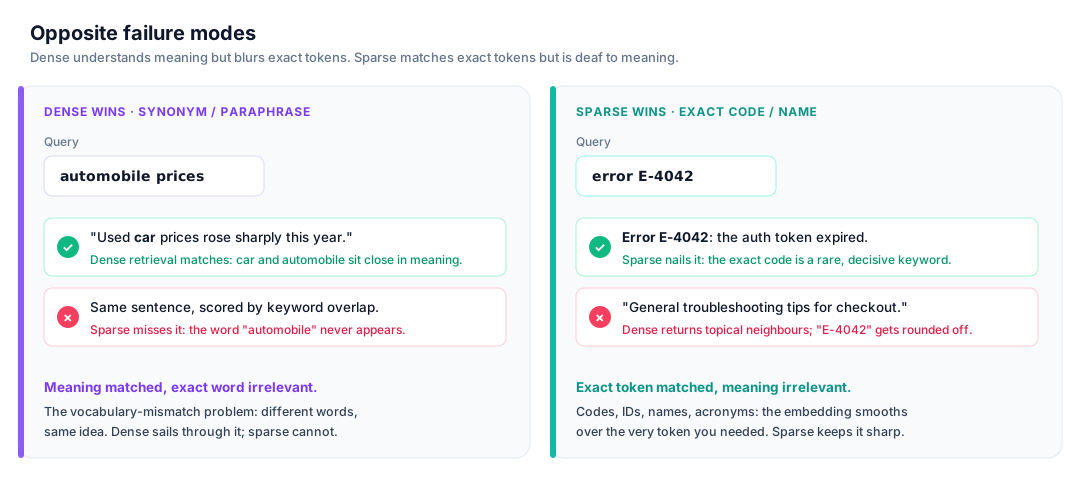
When two methods fail in opposite directions, the move is obvious: stop choosing between them and combine them.
Hybrid search
Hybrid search runs both retrievers over the same query and merges their results into a single ranked list, aiming to keep the semantic recall of dense and the lexical precision of sparse. The only real question is how to merge, and there are two common strategies.
Score combination (weighted sum)
The direct approach: take each retriever’s scores, combine them into one number per chunk, and re-rank. We use a weighted sum, a convex combination governed by a knob usually called alpha:
combined = alpha * dense_score + (1 - alpha) * sparse_scoreAlpha trades the two off: push it toward 1 and you lean on meaning, toward 0 and you lean on keywords. A value around 0.5 splits the difference.
There is one catch you cannot skip: dense and sparse scores live on completely different scales. Cosine similarities sit in a tidy range near 0 to 1, while BM25 scores are unbounded and can run into double digits. Add them raw and BM25 simply drowns out cosine; the alpha knob becomes meaningless. So before any weighted sum you must normalize each score list onto a common range (min-max scaling to 0 to 1 is the usual choice). Normalization is not optional polish here; it is what makes the combination honest.
Reciprocal Rank Fusion (RRF)
The second strategy sidesteps the scale problem entirely by throwing away the raw scores and merging by rank instead. Reciprocal Rank Fusion (RRF) gives each chunk points based on its position in each list: a chunk at rank 1 earns 1 / (k + 1), at rank 2 earns 1 / (k + 2), and so on, where k is a small constant (60 is the common default). Sum a chunk’s points across both lists, and re-rank by the total.
The intuition: appearing near the top of either list is worth a lot, and appearing near the top of both is worth even more, while exact score magnitudes never enter the picture. Because it only ever compares positions, RRF is immune to the normalization headache that haunts the weighted sum. That robustness, plus having only one gentle parameter, is why RRF is such a popular default and the merge built into many vector databases.
Which one should you reach for?
It is tempting to crown one of these the winner, but they answer different questions, and the honest framing is about default versus ceiling.
RRF is the better default. It needs no tuning, it cannot be broken by mismatched score scales, and it behaves sensibly the moment you wire it up. You hand it two ranked lists and it just works, which is exactly what you want before you have a labelled dev set or any sense of how your two retrievers’ scores are distributed. Most teams should start here and may never need to leave.
Weighted sum has the higher ceiling, but only if you earn it. The cost is real: you have to normalize honestly, and you have to tune alpha against a dev set of queries with known-relevant chunks. Once you pay that cost, the weighted sum can beat RRF, because it uses information RRF deliberately throws away. RRF only knows that a chunk was ranked second; the weighted sum knows that it scored 0.91 versus the next chunk’s 0.40, that the gap is huge, that this match is decisive rather than marginal. When your scores are calibrated (when a 0.9 cosine reliably means more than a 0.6, and your BM25 scores are stable across queries), that magnitude information is signal, and a tuned alpha exploits it. The flip side is the failure mode: a single per-query outlier score can dominate a poorly normalized weighted sum, whereas RRF shrugs it off.
So the practical path is RRF first, and weighted sum later, once you have an evaluation set worth tuning against and evidence that the extra ceiling is worth the tuning burden. Reach for the ceiling only after you can measure whether you have actually reached it.
Either way, hybrid usually wins. It gets semantic recall and lexical precision in one list, and it is more robust across query types: the woolly conceptual question and the give-me-this-exact-code question both get answered well, instead of the system being great at one and hopeless at the other.
The figure below makes it tangible. It is the centerpiece of this part, so spend a minute with it.
Notice what happens. In the dense list, the E-4042 chunk languishes near the bottom. In the sparse list it is first. In the merged list it climbs into the top results, rescued, and as you slide alpha toward the sparse side it climbs higher still. That is hybrid search earning its keep on exactly the query our naive app failed.
💡 From experience
The first time hybrid search saved me, I had spent two days blaming the embedding model. A whole class of user queries, the ones with an exact order ID or part number in them, kept returning sensible-looking but wrong chunks, and I cycled through fancier embedding models and finer chunking convinced the problem was upstream. It was not. The queries all shared one trait: they hinged on a rare literal token that semantic search was averaging into oblivion. Bolting a BM25 retriever onto the existing pipeline and fusing with RRF fixed the entire category in an afternoon. The lesson stuck: when retrieval fails specifically on codes, names, and IDs, do not reach for a bigger model, reach for keywords.
Cross-lingual retrieval
So far we have assumed query and corpus speak the same language. Many real corpora do not: a German user asks a question of an English knowledge base, or a support archive mixes Turkish, English, and a sprinkling of product names that belong to no language at all. This changes the calculus for both retrievers, and it is worth knowing the failure modes before you trip over them.
Dense retrieval has a genuine edge here, if the embedding model was trained to be multilingual. A model trained on aligned text across languages places “car”, “Auto”, and “araba” near each other in the same space, so a German query can find an English chunk with no translation step at all. That is the cleanest version of cross-lingual retrieval, and it is a real reason to prefer a multilingual embedding model when your corpus is mixed. The common alternative when your embedding model is monolingual is translate-query-then-retrieve: machine-translate the query into the corpus language, then run ordinary same-language retrieval. Simple, and it leans on machine translation that is now very good, but it inherits every translation error, and it pushes the whole burden onto one brittle step.
Two failure modes recur often enough to name.
- Transliteration and the literal tokens that survive translation. The exact-token problem from the start of this chapter gets worse across languages, because the one token you most need preserved is the one translation is most likely to mangle. A product name, a person’s name, or a place name often gets transliterated rather than translated (rendered into another script or spelling), so
İstanbulbecomesIstanbul, a name picks up or loses diacritics, and your sparse retriever’s exact match silently breaks. This is the tokenization lesson again, now with an extra adversary. Codes and identifiers should ride through untranslated; make sure your pipeline does not “helpfully” rewrite them. - Calibration across languages. Scores are not comparable across languages the way you assume. A monolingual BM25 run against a translated query produces scores on a different footing than the same query in its native language, and a multilingual embedding model is often better calibrated within a language than across language pairs (cosine 0.7 may mean one thing English-to-English and another German-to-English). That wrecks the weighted-sum fusion from earlier, because alpha was tuned on one footing and is being applied on another. RRF, which ignores magnitudes entirely, is more forgiving here, one more reason it makes a sane cross-lingual default.
The short version: prefer a multilingual embedding model if your corpus is genuinely mixed, treat machine translation as a fallback with known leaks, guard your identifiers against transliteration, and lean on rank-based fusion when scores stop being comparable.
Top-k is a real knob now
We have been treating top-k, the number of retrieved chunks we keep and pass to the generator, as a fixed constant. It is not. It is a dial, and now that retrieval is better, where you set it genuinely matters.
The trade-off is honest in both directions.
Set k too small and you risk missing the chunk that holds the answer. This is exactly our opening failure: the right article was at rank five, but with the cutoff at three it fell outside the net and the generator never saw it. Low recall, and a generator that can only guess because it was starved of the evidence.
Set k too large and a different problem appears. The prompt fills up with marginally relevant chunks, and that noise costs you three ways: it burns context-window budget (the wall from Part 1 is still real), it costs more money per call, and, least intuitively, it can actually make the answer worse. Long, padded contexts trigger a well-documented effect called lost in the middle: models tend to use information at the start and end of a long context more reliably than information buried in the middle, the U-shaped accuracy curve measured by Liu et al. (2023). A relevant chunk stranded in the middle of a long pile can be effectively ignored even though it was retrieved. (The leading explanation is a positional bias in how transformers encode position; newer long-context models mitigate this but do not fully eliminate it.) More context is not free, and past a point it is not even helpful.
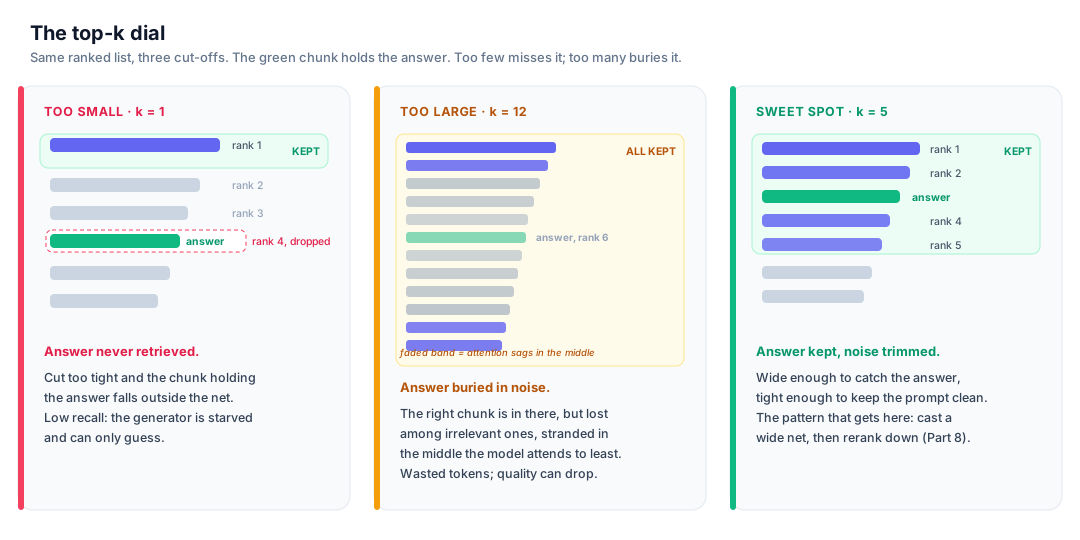
So what is the resolution? You do not have to pick a single perfect k that is both wide enough to catch the answer and tight enough to stay clean, because no such value usually exists. The practical pattern, which the next part is built around, is to split the job in two: cast a wide net, then trim to the best few. Retrieve generously (a large k, so the answer is almost certainly in the candidate pool), then apply a second, sharper pass that reorders those candidates and keeps only the very best handful for the prompt. That second pass is reranking, and it is the heart of Part 8. For now, the takeaway is just that top-k is a real decision with a real trade-off, and the way out is to retrieve more than you will ultimately use.
Extend the app: add sparse and fuse
Let me close the loop with a focused code addition. This is an extension of the Part 6 app, not a rebuild: we keep its dense retriever exactly as is and add a BM25 retriever plus a fusion step beside it. The full runnable file lives at rag_hybrid.py; here are the pieces that matter.
A compact BM25, scoring every chunk against the query. The comments mark the two BM25 ideas from earlier, saturation and length normalization:
import math, re
from collections import Counter

def tokenize(text):
    # keep hyphenated codes like "e-4042" intact as one token
    return re.findall(r"[a-z0-9]+(?:-[a-z0-9]+)*", text.lower())

class BM25:
    def __init__(self, corpus, k1=1.5, b=0.75):
        self.k1, self.b = k1, b                  # k1: saturation, b: length norm
        self.docs = [tokenize(d) for d in corpus]
        self.avgdl = sum(len(d) for d in self.docs) / len(self.docs)
        df = Counter(t for d in self.docs for t in set(d))
        # IDF: rare terms (small df) weigh far more than common ones
        self.idf = {t: math.log(1 + (len(self.docs) - n + 0.5) / (n + 0.5))
                    for t, n in df.items()}

    def scores(self, query):
        q = tokenize(query)
        out = []
        for doc in self.docs:
            tf, s = Counter(doc), 0.0
            for term in q:
                if term not in tf:
                    continue
                freq = tf[term]
                # term frequency that saturates, then length-normalized
                s += self.idf.get(term, 0.0) * freq * (self.k1 + 1) / (
                    freq + self.k1 * (1 - self.b + self.b * len(doc) / self.avgdl))
            out.append(s)
        return out
The two fusion functions. Weighted sum needs normalization first; RRF does not:
def min_max(scores):
    lo, hi = min(scores), max(scores)
    if hi == lo:
        return [0.0 for _ in scores]
    return [(s - lo) / (hi - lo) for s in scores]   # onto 0..1 so scales match

def weighted_fusion(dense, sparse, alpha=0.5):
    d, s = min_max(dense), min_max(sparse)          # MUST normalize before summing
    return [alpha * d[i] + (1 - alpha) * s[i] for i in range(len(d))]

def rrf(*rankings, k=60):
    # each ranking is a list of doc indices, best first; merge by rank, not score
    fused = Counter()
    for ranking in rankings:
        for rank, doc_id in enumerate(ranking, start=1):
            fused[doc_id] += 1.0 / (k + rank)
    return fused
And the run. We reuse Part 6’s dense_search for the dense scores, add BM25 for the sparse scores, and fuse:
dense  = dense_search(QUERY, CORPUS)   # from Part 6: cosine over embeddings
sparse = BM25(CORPUS).scores(QUERY)    # new: keyword overlap

fused  = rrf(order(dense), order(sparse))   # order() = indices sorted best-first
Running it on our problem query prints the rescue plainly:
Query: 'how do I fix error E-4042 at checkout?'

DENSE only (meaning):
  1. Troubleshooting checkout and payment failures...
  2. Resolving login and authentication issues...
  3. The checkout page shows a generic error after Pay...

SPARSE only (BM25 keywords):
  1. Error E-4042: the authentication token has expired...   <- found it
  2. The checkout page shows a generic error after Pay...
  3. Troubleshooting checkout and payment failures...

HYBRID via RRF:
  1. Troubleshooting checkout and payment failures...
  2. The checkout page shows a generic error after Pay...
  3. Error E-4042: the authentication token has expired...   <- rescued
Dense alone never surfaces the E-4042 chunk in its top three (it sits at rank five, the code rounded off). Sparse ranks it first. The fused list pulls it back into the top three, and pushing alpha toward the sparse side in weighted_fusion lifts it higher still. That is the exact failure from the opening of this chapter, fixed, with maybe forty lines added to the app we already had.
A freshness note: BM25 and dense embedding both have excellent off-the-shelf libraries (rank_bm25, sentence-transformers, and the hybrid mode built into most vector databases), and their APIs change quickly. The hand-rolled BM25 above is for understanding the mechanism. Before you ship, prefer a maintained library and verify its current usage.
⚠️ Common pitfalls
- The tokenizer shatters your codes. This is the single most common reason “BM25 cannot find an exact code that is right there.” A default analyzer splits
E-4042on the hyphen intoeand4042, stems or normalizes the pieces, and the rare, decisive token you were counting on dissolves into common dust. Tokenize the query and the documents the same way, and configure an exact/keyword field for identifiers. Verify it: print the token list for a known code and confirm it survives whole.- Per-query min-max normalization is fragile. Min-max scaling to 0..1 is computed per query, so a single outlier score stretches or compresses the whole range, and a query that happens to return one runaway BM25 score can squash every other chunk toward zero. The alpha you tuned on average-looking queries then misbehaves on the odd one. RRF avoids this entirely by ignoring magnitudes; if you do use weighted sum, sanity-check it on your weird queries, not just your clean ones.
- Forgetting to dedup before you fuse. Dense and sparse return overlapping candidate sets, and if the same chunk appears under two different ids (or you merge lists without collapsing duplicates), fusion double-counts it and floats a near-duplicate to the top. Dedup the union of candidates to a single entry per chunk before RRF or weighted sum runs, or the merge quietly rewards redundancy.
Try it yourself
The interactive figure and rag_hybrid.py are built for poking at. Three experiments make the chapter’s claims concrete in a few minutes.
- Sweep RRF’s
kfrom 1 to 100. Inrrf, the constantkdamps how much a top rank dominates. Callrrf(dense_rank, sparse_rank, k=1)and thenk=100and reorder each time. At a tinyk, rank 1 in either list is overwhelmingly decisive (the gap between1/2and1/3is large), so theE-4042chunk that sparse ranks first jumps up to rank 2 in the merge; at a largek, all ranks flatten toward equal weight and the two lists blend more gently, settling it at rank 3. The paper’s default of 60 sits deliberately in that calm upper region. Watch the code chunk slide between rank 2 and rank 3 as you turn the dial, and notice how gentle the whole effect is:kshapes the blend, it does not flip the outcome. - Flip alpha to find where
E-4042reaches rank 1. Callweighted_fusion(dense, sparse, alpha=a)forastepping from 1.0 down to 0.0 and reorder each time. Atalpha=1.0you have pure dense and the code chunk languishes at rank 5; as you lean toward sparse it climbs, reaching rank 1 once alpha drops to about 0.2. Record the exact crossover. That single number is the whole dense-versus-sparse trade-off made visible on one query. - Break
tokenizeand watch the code shatter. Temporarily change the regex intokenizetore.findall(r"[a-z0-9]+", text.lower())(dropping the(?:-[a-z0-9]+)*part), which splits on hyphens like a naive analyzer. Printtokenize("Error E-4042")before and after: you will see["error", "e-4042"]become["error", "e", "4042"]. Re-run the demo and watch the sparse ranking forE-4042degrade as the rare token dissolves into the common4042. This is the production failure from the tokenization section, reproduced by deleting fifteen characters from one regex.
Recap and what’s next
We started Part 7 with a working but naive app: pure dense retrieval and a fixed top-k, failing on a question whose answer was sitting right there. We now understand why. Dense retrieval is fluent in meaning but blurs exact tokens; sparse retrieval is precise on exact tokens but deaf to meaning; and because they fail in opposite directions, hybrid search fuses them, by weighted sum or by Reciprocal Rank Fusion, to get the best of both. We also promoted top-k from a hidden constant to a deliberate dial, with low recall on one side and noise and lost-in-the-middle on the other.
But even excellent retrieval only gets you a ranked list that is roughly right. The truly best chunk for the question might still be sitting at rank five of your generously retrieved candidates, outscored by chunks that merely look relevant. Part 8 is about squeezing the last bit of quality out of that list: reranking with cross-encoders (a slower, sharper model that re-scores the top candidates by reading the query and chunk together), plus metadata filtering and query transformations. We cast the wide net here; next we trim it expertly.
Key takeaways
- Dense (semantic) retrieval ranks by meaning and excels at synonyms and paraphrase, but it blurs exact tokens (codes, IDs, names, rare acronyms): the embedding rounds off the very keyword you needed.
- Sparse (keyword) retrieval scores by literal term overlap. TF-IDF weights terms by frequency-here times rarity-everywhere; BM25 refines it with term-frequency saturation and document-length normalization, and is the dependable default in keyword engines. It nails exact matches but cannot bridge vocabulary mismatch (car versus automobile).
- The two fail in opposite directions, which is exactly why combining them works.
- Hybrid search merges both. Weighted sum needs score normalization first (the scales differ) and an alpha to trade them off; Reciprocal Rank Fusion (RRF) merges by rank, sidestepping normalization, which makes it a robust default.
- Top-k is a real knob: too small misses the answer (low recall, starved generator); too large adds noise, wastes budget, and triggers lost in the middle.
- The pattern that resolves the top-k tension is to retrieve generously, then rerank down to the best few, which is Part 8.
References
- Robertson, S., & Zaragoza, H. (2009). The Probabilistic Relevance Framework: BM25 and Beyond. Foundations and Trends in Information Retrieval, 3(4), 333-389. https://doi.org/10.1561/1500000019: the definitive treatment of BM25, deriving its term-frequency saturation and document-length normalization from the probabilistic relevance model.
- Cormack, G. V., Clarke, C. L. A., & Buettcher, S. (2009). Reciprocal Rank Fusion Outperforms Condorcet and Individual Rank Learning Methods. SIGIR ‘09, 758-759. https://doi.org/10.1145/1571941.1572114: the paper that introduced RRF; its pilot found k=60 near-optimal and noted the choice “was not critical,” which is why 60 is the common default.
- Liu, N. F., Lin, K., Hewitt, J., Paranjape, A., Bevilacqua, M., Petroni, F., & Liang, P. (2023). Lost in the Middle: How Language Models Use Long Contexts. https://arxiv.org/abs/2307.03172: the empirical U-shaped accuracy curve cited for the top-k noise failure mode.
Glossary
- Dense retrieval: ranking chunks by cosine similarity between dense query and chunk embeddings; strong on meaning, weak on exact rare tokens.
- Sparse retrieval: ranking chunks by overlap of literal terms; the vector spans the whole vocabulary and is almost all zeros, hence “sparse.”
- TF-IDF: term frequency times inverse document frequency, a classic sparse weighting that favors terms frequent in a chunk but rare across the collection.
- Term frequency (TF): how often a term appears in a given chunk; more occurrences, higher weight.
- Inverse document frequency (IDF): how rare a term is across all chunks; common words are crushed, rare words are amplified.
- BM25: the robust refinement of TF-IDF used in most keyword engines, adding term-frequency saturation (diminishing returns) and document-length normalization.
- Vocabulary mismatch: when query and chunk express the same idea in different words, so a literal keyword method sees no overlap; the weakness sparse retrieval cannot escape.
- Hybrid search: running dense and sparse retrieval together and merging their results into one ranked list.
- Score normalization: rescaling each retriever’s scores onto a common range (often 0 to 1) so a weighted sum is meaningful; mandatory because dense and sparse scores live on different scales.
- Alpha (weighted combination): the knob in a weighted sum that trades dense against sparse (1 is all dense, 0 is all sparse).
- Reciprocal Rank Fusion (RRF): merging by rank rather than raw score, where each chunk earns 1/(k + rank) from each list; robust because it needs no normalization.
- Top-k: the number of retrieved chunks kept and passed to the generator; a trade-off between recall and noise.
- Lost in the middle: the empirically measured tendency (Liu et al., 2023) for language models to use information in the middle of a long context less reliably than information at the start or end, so a relevant chunk buried there can be effectively ignored.
Next up, Part 8: Making Retrieval Smarter. We cast a wide net in this part; next we trim it with cross-encoder reranking, metadata filtering, and query transformations, so the best chunk is not just retrieved but ranked first.