2026-06-15
Advanced Retrieval Patterns
Eight parts in, your pipeline retrieves well. But it still assumes one unit of text does triple duty: the thing you embed, the thing you search, and the thing you hand the model. Part 9 of a from-scratch series on Retrieval-Augmented Generation breaks that assumption. The big idea is decoupling: the best unit to search on (small, sharp) is rarely the best unit to generate from (large, rich). Four patterns put it to work, parent-document, sentence-window, self-querying, and contextual compression, with one focused code addition on the running app.
What you’ll learn
For eight parts we have been sharpening retrieval from every angle. We built the pipeline by hand (Part 6), added sparse and hybrid search (Part 7), then layered on metadata filtering, query transformations, and reranking (Part 8). We made the query better, the candidate set better, and the ranking better. But we never questioned the one thing every part quietly assumed: that a single piece of text should do triple duty as the thing we embed, the thing we search, and the thing we hand to the model. This part names that assumption and breaks it. The whole chapter rests on one idea, decoupling the unit you search from the unit you generate from, and four patterns that put it to work. You will leave able to look at a failing answer and say “the retrieval is fine, it is the unit that is wrong,” and know which pattern fixes it.
Prerequisites
Parts 1 through 8, and especially two of them. Documents and Chunking (Part 5), because this entire chapter is the resolution to the chunk-size dilemma it raised. And Build Your First RAG (Part 6), whose small Python app we extend at the end. Part 7 (Retrieval Deep Dive) and Part 8 help, since these patterns sit happily alongside hybrid search, filtering, and reranking. Basic Python is assumed; the code is one focused addition, not a rebuild.
The assumption we never questioned
Here is the shape of every pipeline we have built. We take a document, split it into chunks, embed each chunk into a vector, and store it. A query comes in, we embed it, we find the nearest chunks, and we paste those exact chunks into the prompt. Notice that one object, the chunk, plays three roles without complaint:
- It is embedded: turned into the vector that represents its meaning.
- It is searched: that vector is what the query is compared against.
- It is generated from: its text is what the model reads to answer.
We have spent eight parts improving how we use this object and never once asked whether the same object should play all three roles. It should not. And the moment you see why, a problem that has been nagging since Part 5 dissolves.
Recall the chunk-size dilemma. Small chunks (a sentence, a line) retrieve precisely: the vector is about one idea, so it matches sharply and is rarely diluted by unrelated text sitting in the same chunk. But a single sentence is thin: hand it to the model and it has no surrounding context to reason with, so it answers narrowly or wrongly. Large chunks (a section, a page) are the mirror image: they give the model plenty of context to generate a full answer, but they retrieve fuzzily, because one vector now has to average together five different ideas, and that blurred average matches everything weakly and nothing sharply. In Part 5 we treated this as a dial to tune: pick a chunk size that is the least-bad compromise for both jobs.
The insight of this chapter is that it was never one dial. It was two jobs wearing one mask. The fix is not a better compromise, it is to stop compromising:
Decouple the unit you search from the unit you return. Search on something small and sharp. Hand the model something large and rich. They do not have to be the same text.
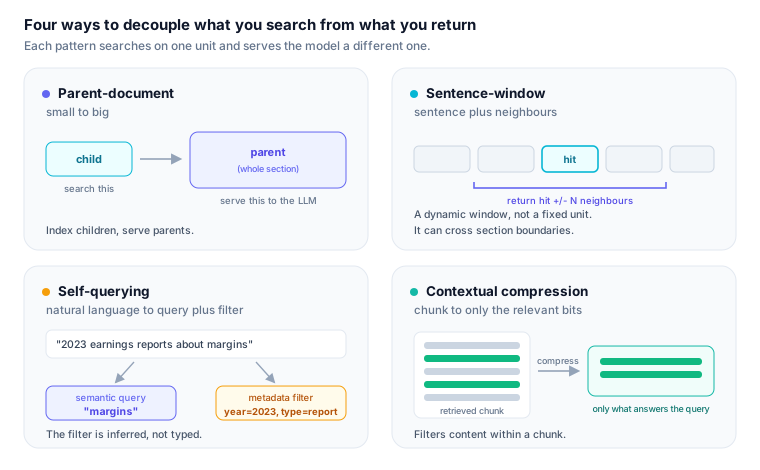
Every pattern below is a different answer to the question “small to search, big to generate, how exactly?” Here is the map of the four we will cover.
Pattern 1: Parent-document retrieval (small to big)
This is the purest expression of decoupling, so we start here.
The problem: your small chunks match beautifully, but when one wins, a lone sentence is not enough for the model to give a complete answer. It found the right place in the document and then handed the model a peephole view of it.
The pattern: split each document twice. Cut it into large parent chunks (a paragraph, a section, sometimes the whole document), the unit you would like the model to read. Then cut each parent into small child chunks (a sentence or two), the unit that retrieves sharply. You embed and search only the children. When a child wins, you do not return it. You look up the parent it came from and return that to the model. Index children, serve parents.
Parent chunk: a larger unit of text (paragraph, section, document) that gives the model enough context to answer well. Child chunk: a small unit (a sentence or two) carved from a parent, embedded and searched for sharp matching. A child is never sent to the model on its own; it is a pointer to its parent.
The mechanics are just bookkeeping. Alongside the child vectors, you keep a map from each child back to its parent. A child wins the vector search; you follow the map; you serve the parent. That is the entire pattern, and we will write the eleven lines that do it later in this part.
When to reach for it: the failure mode is unmistakable. Retrieval is clearly finding the right region of your documents (your relevance metrics look fine, the matched chunk is on-topic) but answers are thin, miss caveats, or stop just short of the real answer. That gap between “found the right place” and “could not answer from it” is parent-document’s exact signature.
Pattern 2: Sentence-window retrieval
The close cousin. Same goal, a slightly different mechanism, and the contrast between them is worth holding in your head.
Sentence-window takes the small-to-search idea to its limit: you embed and retrieve at the level of a single sentence, the sharpest possible unit. But on a hit, instead of returning a pre-defined parent, you return the matched sentence plus a window of its N neighbours, the sentences immediately before and after it in the original document. The model gets the hit in its natural surroundings.
The difference from parent-document is subtle but real. Parent-document returns a fixed, pre-defined unit: whichever section or paragraph the child was carved from, with boundaries you decided at indexing time. Sentence-window returns a dynamic window centred on the hit, computed at query time, and it does not care about your section boundaries: if the hit is the last sentence of one section, the window happily reaches into the next one. Parent-document respects the document’s structure; sentence-window respects proximity to the match. Reach for sentence-window when the relevant context is “whatever is physically near this sentence” rather than “the section this sentence belongs to,” for example in flowing prose, transcripts, or articles where ideas bleed across your chosen boundaries. Reach for parent-document when your documents have meaningful structure (policy sections, API methods, contract clauses) and the right context is the whole structural unit.
The interactive below makes the distinction concrete. Watch a query match one small child, then toggle between the two patterns to see what the model actually receives: the whole parent section, or a window that spills across the boundary.
Pattern 3: Self-querying retrieval
The first two patterns change what text a hit expands into. The next one changes how the search itself is shaped from the user’s words.
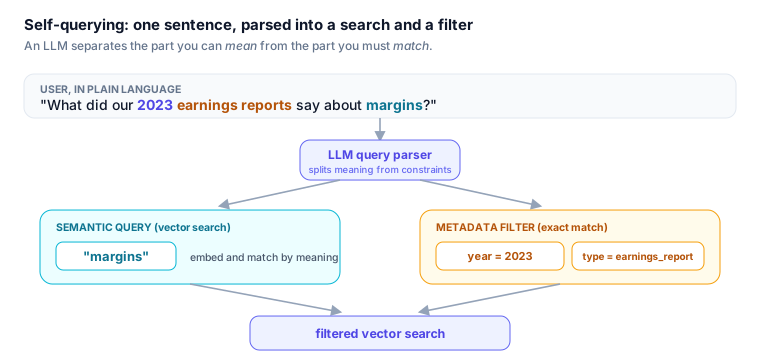
The problem: real questions mix two different kinds of request. Take “what did our 2023 earnings reports say about margins?” The word “margins” is a semantic ask: you want chunks that are about margins, and only an embedding can judge that. But “2023” and “earnings reports” are not semantic at all. They are hard constraints, exact filters on metadata. Pure vector search treats the whole sentence as one blob of meaning and quietly ignores the constraints: it will cheerfully return a 2021 forecast that happens to discuss margins, because nothing told it that the year was non-negotiable. In Part 8 we fixed this with metadata filtering, but we wrote the filter by hand. Users do not write filters. They write sentences.
The pattern, self-querying: put a small LLM call in front of retrieval whose only job is to parse the natural-language question into two outputs, (a) a clean semantic search string and (b) a structured metadata filter. Then run a filtered vector search, exactly the Part 8 mechanism, except the filter was inferred from the sentence automatically instead of typed by you.
Self-querying: using an LLM to read a natural-language question and emit both a semantic query and a structured metadata filter, so the system applies hard constraints the user expressed in plain words.
The catch is the one we keep meeting: this adds an LLM call before every search, with its latency, cost, and a small chance of a malformed filter. So you only reach for it when your corpus genuinely has structured metadata worth filtering on (dates, document types, authors, categories) and your users phrase those constraints in natural language. For a corpus with no useful metadata, there is nothing to infer, and self-querying is pure overhead.
Pattern 4: Contextual compression
The first three patterns decide which text reaches the model. The last one cleans up the text itself once it has been chosen.
The problem: even a perfect retrieval returns chunks that are mostly padding. A chunk that genuinely contains the answer also contains four sentences that have nothing to do with this particular question. That noise is not harmless. It burns context budget you are paying for, and worse, it dilutes the signal: recall “lost in the middle” from Part 7, where a model uses information buried in the middle of a long, noisy context less reliably than what sits at its ends. Relevant chunks, full of irrelevant sentences, make the answer worse.
The pattern, contextual compression: after retrieval and before generation, run each chunk through a step that strips it down to just the parts relevant to the query. Two flavours:
- Extractive compression pulls out the relevant sentences verbatim and drops the rest. It is cheap, it cannot invent anything, and it never distorts wording. Its ceiling is that it can only keep what is literally there.
- Abstractive compression uses an LLM to distil the chunk into a short, query-focused summary in its own words. It can compress harder and synthesise across sentences, at the cost of another LLM call and a small risk of dropping or warping something.
Contextual compression: filtering the content within each retrieved chunk down to the query-relevant parts before generation. Extractive vs. abstractive: extractive keeps the original sentences that matter; abstractive rewrites them into a shorter summary.
It is worth lining this up against Part 8’s metadata filtering, because they sound similar and do opposite things. Metadata filtering removes whole chunks before the search, on a hard rule (wrong year, drop it). Contextual compression removes content inside a chunk after the search, on relevance to this query. One decides which chunks exist; the other trims the chunks that survived. The trade-off is the familiar one: an extra processing pass per chunk (cost and latency), plus the risk, especially with abstractive, of compressing away something that turns out to matter. Reach for it when your retrieved chunks are large and noisy and you can see the context window filling with filler, not when your chunks are already tight.
A couple of relatives, in passing
Two more patterns deserve a name so you recognise them in the wild. They are natural extensions of what you now understand, and they point toward the more autonomous architectures of Part 10.
Auto-merging retrieval is parent-document with a quorum. You retrieve small children as usual, but instead of always promoting every hit to its parent, you only merge children back into their parent when enough of that parent’s children were retrieved. A single stray hit returns just its small chunk; three hits from the same section are a strong signal that the whole section is relevant, so you merge them up. It is a way to let the amount of evidence decide how much context to return. Our code at the end does the de-duplication step this builds on.
Hierarchical (or summary) indexing retrieves in two stages. You first index a short summary of each document and search those to find the right document, then retrieve among the chunks within that document. It is routing: cheaply narrow to the right source, then search inside it. Useful when you have many distinct documents and most chunks in the corpus are irrelevant noise for any given query.
Keep these light for now. They are the bridge to Part 10, where retrieval stops being a single fixed step and starts to loop and decide.
How to choose, and how to combine
The most important thing to internalise is that these are not mutually exclusive, and not a menu you pick one item from. They are independent moves that stack. A mature pipeline might self-query to build a filter, run hybrid search (Part 7) inside that filter, retrieve small children and serve their parents, rerank the parents (Part 8), and compress the survivors before generation. Every one of those is solving a different, specific problem.
Which is exactly the discipline to hold onto. Do not add these by default. Each pattern buys a fix for one named failure at the price of latency, cost, or complexity. Add one when your failure analysis points at the specific problem it solves, and not before.
| Pattern | The problem it solves | Cost added | Reach for it when | | --- | --- | --- | --- | | Parent-document | Sharp matches, but a lone chunk starves the model of context | Index/lookup bookkeeping; bigger prompts | Retrieval finds the right place but answers are thin or miss caveats | | Sentence-window | Same, but the right context is proximity not structure | Trivial; bigger prompts | Flowing prose, transcripts; ideas cross your chunk boundaries | | Self-querying | Users hide hard constraints (dates, types) inside natural language | One LLM call per query; latency | The corpus has real metadata and users phrase filters in words | | Contextual compression | Retrieved chunks are padded with query-irrelevant noise | A processing pass per chunk; risk of over-trimming | Large, noisy chunks; the context window fills with filler |
How do you know whether a pattern actually helped? You measure. That is Part 11, evaluation, where we stop reasoning about which pattern should help and start proving which one does. For now, the rule is simply: change one thing, then check the answers got better.
💡 From experience
The first time this clicked for me, I had spent a full day convinced my retrieval was broken. Every query I tried, the top chunk was exactly the right sentence: my relevance numbers were great, the matched text was spot on. And the answers were still wrong. The model kept saying refunds were unconditional, when the policy clearly had an “unused and in original packaging” condition. The retrieval was not broken at all. I was indexing tiny sentence chunks, and the one that matched (“refunds are accepted within 30 days”) was a different sentence from the one with the condition. The model only ever saw the peephole. The fix was eleven lines: keep the small chunks for searching, but return the whole parent paragraph to the model. The “bug” was never in the search. It was in the unit. That is the day I stopped tuning chunk size and started decoupling.
Extend the app: parent-document on the running code
Let us make the purest pattern real on the Part 6 app. The change is small by design: we are not rebuilding retrieval, we are adding a layer of bookkeeping around it. We split each document into large parents and small children, search the children, keep a child to parent map, and return the parent on a hit.
# rag_parent_document.py  -  parent-document retrieval on the Part 6 app.
# The whole idea in one line: INDEX CHILDREN, SERVE PARENTS.

import re

# Each string is a PARENT: a coherent section, the unit generation wants.
PARENTS = [
    # parent 0
    "Refunds. We accept refunds within 30 days of purchase. To qualify, the item "
    "must be unused and in its original packaging. To start a return, email "
    "support@example.com with your order number. Once we receive the item, your "
    "refund is processed back to the original payment method within five business "
    "days. Shipping fees are not refundable.",
    # parent 1
    "Exchanges. If you want a different size or color, request an exchange instead "
    "of a refund. Exchanges ship free of charge. Items marked final sale cannot be "
    "returned or exchanged. Gift cards are non-refundable and cannot be exchanged.",
    # parent 2
    "Warranty. All electronics include a one-year limited warranty that covers "
    "manufacturing defects. The warranty does not cover accidental damage or normal "
    "wear. To make a warranty claim, contact support with a photo of the defect and "
    "your order number.",
]

def split_sentences(text):                       # children are single sentences
    return [s.strip() for s in re.split(r"(?<=[.!?])\s+", text) if s.strip()]

# Build the children AND the map back to their parent, side by side.
children, child_to_parent = [], []
for p_idx, parent in enumerate(PARENTS):
    for sentence in split_sentences(parent):
        children.append(sentence)                # the small unit we SEARCH
        child_to_parent.append(p_idx)            # remember where it came from
The only new state is child_to_parent, a list as long as children, where entry i is the index of the parent that child i was carved from. Now the retrieval. In your real app, child_scores is Part 6’s cosine-over-embeddings search run against the child vectors; the lookup at the end is what is new:
def retrieve_small_return_big(query, k_children=3):
    scores = child_scores(query)                 # Part 6 search, but over CHILDREN
    top = sorted(range(len(children)),
                 key=lambda i: scores[i], reverse=True)[:k_children]
    # Follow each winning child back to its parent, de-duplicated.
    # (Returning each parent once is the seed of "auto-merging" retrieval.)
    parent_ids = list(dict.fromkeys(child_to_parent[i] for i in top))
    return {
        "matched_child": children[top[0]],       # what we SEARCHED and hit
        "returned_parents": [PARENTS[p] for p in parent_ids],  # what the LLM GETS
    }
Run it on a question about timing, whose sharp match is a thin sentence, and watch the before/after of what the model actually receives (the output below is the file’s deterministic keyword-overlap fallback, used so it runs with no model installed):
Query: 'how long until I get my refund after sending the item back?'

NAIVE  (search small, return small)  ->  the LLM receives:
  [0.211] Once we receive the item, your refund is processed back to the
          original payment method within five business days.

PARENT-DOCUMENT  (search small, return big)  ->  the LLM receives:
  Refunds. We accept refunds within 30 days of purchase. To qualify, the item
  must be unused and in its original packaging. To start a return, email
  support@example.com with your order number. Once we receive the item, your
  refund is processed back to the original payment method within five business
  days. Shipping fees are not refundable.
The naive path matched a single true sentence about timing and starved the model: that sentence never mentions the 30-day window or the “unused and in original packaging” condition that a returns question can hinge on. Parent-document hands over the whole refund section. Same sharp match; far more to answer from. With the real sentence-transformers model the match is sharper still (cosine around 0.855 on the very same timing sentence), and it still lives inside the refund parent, so the parent you serve is identical. The matched child is an implementation detail. The parent you serve is the answer. The full runnable file, including a transparent fallback scorer so it runs without any model installed, is rag_parent_document.py.
Try it yourself
The point of rag_parent_document.py is to make the decoupling visible by changing one thing at a time. Two experiments are worth running yourself.
First, change the demo query and watch which child wins while the same parent is served. The default query is about refund timing, which matches the “five business days” sentence. Swap it for "do I have to keep the box my order came in?" and a different child wins (the “unused and in its original packaging” sentence), but it still lives in parent 0, so the model receives the identical refund section. That is the whole lesson in one keystroke: which sentence you search on is an implementation detail; which parent you serve is the answer. The match moved, the served context did not.
Second, raise k_children and watch the parent de-duplication do its job. The __main__ demo calls retrieve_small_return_big(query, k_children=1) to keep the before/after crisp. Bump it to k_children=3 and the top three children will often point back into the same parent (a returns question lights up several sentences in the refund section). The line parent_ids = list(dict.fromkeys(child_to_parent[i] for i in top)) collapses those duplicate hits into a single parent, so you do not paste the same paragraph into the prompt three times. Try a query that spans sections, like "what are my options if the size is wrong, refund or exchange?", and you will see two distinct parents come back instead. That de-duplication is exactly the seed of auto-merging retrieval: it is already counting how many children of a parent were hit, one short step from letting that count decide whether to merge.
⚠️ Common pitfalls
- A self-querying LLM will confidently invent a filter field that does not exist in your store. Ask it to filter “by department” when your metadata only has
yearandtype, and it may emit{"department": "finance"}against a field nothing was ever indexed under. Depending on the store, that either throws or silently matches nothing, and the user just sees an empty answer. Always validate the parsed filter against a known schema (an allow-list of fields and, ideally, their types) before it touches the vector store, and on a mismatch drop the bad clause or fall back to an unfiltered search rather than passing it through blind.- Parent-document and auto-merging can blow your context budget when parents are huge. The pattern is seductive precisely because bigger parents give the model more to work with, but “the whole document” as a parent means one sharp child hit can dump tens of thousands of tokens into the prompt, and three hits across three large parents can overflow the window outright (or quietly trigger “lost in the middle” from Part 7). Size your parents deliberately (a paragraph or a section, not a book), cap how many parents you serve, and if your parents are genuinely large, pair the pattern with contextual compression so what reaches the model is large and clean rather than just large.
Recap and what is next
Step back and notice what changed. For eight parts we improved retrieval by improving the query, the candidate set, and the ranking. This part improved it by changing the unit: search on something small and sharp, generate from something large and clean, and stop pretending they must be the same text. That single move, decoupling, dissolves the chunk-size dilemma and gives you four concrete tools to apply it.
But look at the pipeline we have built. For all its sophistication, it is still static and linear: one fixed path from query to answer, the same sequence of steps every time, no matter the question. It never asks “did that retrieval actually work?” It never tries again. Part 10 breaks that open. We move from pipelines to architectures that reason, decide, loop, and self-correct: agentic RAG, Corrective RAG (CRAG), Self-RAG, GraphRAG, and multi-modal RAG. The system stops being a conveyor belt and starts being a problem-solver.
Key takeaways
- The core move is decoupling. The optimal unit to search on (small, focused, sharp) is rarely the optimal unit to generate from (large, context-rich). They do not have to be the same text, and once you separate them the chunk-size dilemma from Part 5 disappears.
- Parent-document and sentence-window both search small and return big, differing in what “big” means: a fixed pre-defined parent unit, versus a dynamic window of neighbours that can cross structural boundaries.
- Self-querying turns natural language into a search plus a filter, automating the metadata filtering you did by hand in Part 8 so users can express hard constraints in plain words.
- Contextual compression trims content within a chunk after retrieval, where metadata filtering removes whole chunks before it; reach for it when good chunks arrive padded with noise.
- These patterns stack and are not free. They coexist with hybrid search, filtering, and reranking. Add one when failure analysis points at the specific problem it solves, never by default, and confirm it helped by measuring (Part 11).
References
These are the framework docs that turn the four patterns into running code, useful when you want a maintained implementation rather than the by-hand version above.
- LangChain, “ParentDocumentRetriever.” API reference for the parent-document pattern: retrieve small child chunks, then return the larger parent documents they belong to.
- LangChain, “ContextualCompressionRetriever.” API reference for the contextual-compression idea: a retriever that wraps a base retriever and compresses the results, with document compressors such as
LLMChainExtractor(LLM-driven verbatim extraction) andEmbeddingsFilter(similarity-threshold filtering). - LlamaIndex, “Auto Merging Retriever.” Example walking through auto-merging retrieval over a hierarchy of parent and child nodes, merging children back into a parent once enough of that parent’s children are retrieved.
Glossary
- Decoupling the retrieval unit from the generation unit: the central idea of this chapter, that the text you embed and search can and usually should be different from the text you hand to the model.
- Parent-document retrieval: embed and search small child chunks, but on a hit return the larger parent chunk they belong to. “Index children, serve parents.”
- Parent chunk: the larger unit (paragraph, section, document) returned to the model for context.
- Child chunk: the small unit (a sentence or two) that is embedded and searched; a pointer to its parent, never sent to the model alone.
- Sentence-window retrieval: embed and retrieve single sentences, but on a hit return the matched sentence plus a window of N neighbouring sentences.
- Self-querying retrieval: use an LLM to parse a natural-language question into a semantic search string plus a structured metadata filter, then run a filtered vector search.
- Contextual compression: after retrieval, strip each chunk down to just the query-relevant content before generation.
- Extractive vs. abstractive compression: extractive pulls out the relevant sentences verbatim; abstractive uses an LLM to rewrite them into a shorter, query-focused summary.
- Auto-merging retrieval: a variant of parent-document that promotes children to their parent only when enough of that parent’s children were retrieved, letting the amount of evidence decide how much context to return.
- Hierarchical (summary) indexing: index short document summaries to route a query to the right document first, then retrieve among that document’s chunks.
Next: Part 10, Advanced RAG Architectures, where the pipeline stops being a straight line and learns to reason, loop, and correct itself.