2026-06-21
Adaptive RAG
Not every query needs the same machinery: a greeting needs no retrieval, a fact needs one lookup, a comparison needs several. Part 15 of a from-scratch series on Retrieval-Augmented Generation and the close of the Frontier Track: a small complexity classifier that routes each query to no-retrieval, single-step, or multi-step retrieval, unifying the pipelines built across Parts 6 to 10 into one adaptive system.
What you’ll learn
For fourteen parts we have built retrieval pipelines and then run them the same way for every question that walks in the door. This part fixes the last thing left unexamined: the assumption that one pipeline should serve every query. We will build a tiny complexity classifier, a function that looks at an incoming query and decides how much machinery it actually warrants, and then a router that sends each query down one of three paths: no retrieval at all, a single retrieve-then-generate, or a multi-step decompose-retrieve-synthesize. This is Adaptive RAG, and the satisfying part is that we are not inventing a new pipeline. We are putting a conductor in front of the pipelines we already built in Parts 6 through 10 and letting it choose. Along the way I will be careful to separate this idea from two things it superficially resembles: query transformation from Part 8 and source routing from Part 10. They are not the same move, and conflating them is the most common way people get Adaptive RAG wrong.
Prerequisites
This part leans on the whole back half of the series, so it is the one place where I genuinely assume you have the earlier pieces in your head. You need Build Your First RAG (Part 6), because the single-step route is exactly that retrieve-augment-generate loop. You need Making Retrieval Smarter (Part 8) for query decomposition, which the multi-step route reuses, and so we can draw the contrast with query transformation cleanly. And you need Advanced RAG Architectures (Part 10), because the multi-step route is the decompose-and-synthesize shape from there, and because Part 10’s idea of routing by knowledge source is the thing we must take care not to confuse with routing by difficulty. No new math in this part. It is architecture and judgment, with a small amount of deterministic Python you could read in one sitting.
One pipeline does not fit every query
Here is the situation we have quietly been in since Part 6. We built a pipeline, we tuned its retriever, we added reranking and decomposition and grounding, and then we pointed it at every query identically. A user types “hi there” and the system dutifully embeds it, searches the vector store, pulls back the three nearest policy chunks, stuffs them into a prompt, and asks a language model to answer. The model, to its credit, ignores the irrelevant chunks and says hello. But we paid for an embedding, a vector search, and a bloated prompt to produce a greeting that needed none of it.
Now flip it around. A user asks “compare the refund window and the warranty period, and explain the difference.” A single retrieval grabs the chunks nearest to that whole sentence, which might be the refund chunk, or the warranty chunk, or an unlucky mix, but rarely both cleanly, and the model is asked to compare two things when it reliably has evidence for only one. The easy query was over-served. The hard query was under-served. The same fixed pipeline did both, because a fixed pipeline has no way to tell them apart.
The fix is to look at the query first and decide how much work it deserves. That decision, made before retrieval, is the entire idea of Adaptive RAG: a system that classifies each incoming query by complexity and routes it to the pipeline that fits, instead of running one pipeline for all of them. The name comes from the Adaptive-RAG paper (Jeong et al., NAACL 2024, arXiv 2403.14403), which framed it precisely as choosing a retrieval strategy per query rather than committing to one.
Three routes
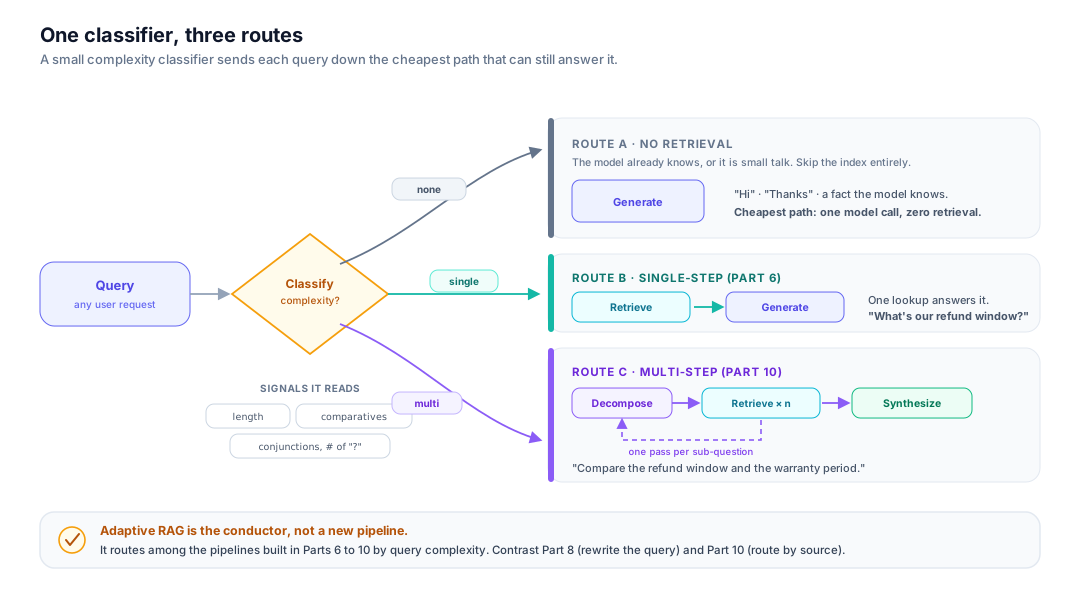
Before we classify anything, let us name the three destinations, because the classifier only makes sense once you know what it is choosing between. All three are pipelines you have already seen.
The first route is no retrieval. Some queries do not need the index at all. “Hi there” and “thanks” are pure conversational glue. A question whose answer the model already holds from its own pretraining, like a definition of a common word, does not need your documents either. For these the right move is to skip retrieval entirely and answer directly. This is the cheapest possible path: one model call, or in our offline build a templated reply, and zero embedding or search. Crucially, this route does not use the Part 6 lookup at all. The whole point is that we recognized we did not need it.
The second route is single-step, and it is the Part 6 pipeline unchanged: embed the query, retrieve the top chunk or two, build a grounded prompt, generate. This is the workhorse. Most factual questions against a knowledge base are single-step queries. “What is our refund window?” needs exactly one lookup against exactly one relevant chunk, and then an answer grounded in it. If your traffic is mostly questions like this, single-step is where most of it should land, and that is fine.
The third route is multi-step, and it is the decompose-retrieve-synthesize shape from Part 10. A query that asks you to compare two things, or that bundles several questions into one sentence, cannot be answered by a single retrieval, because no single chunk holds both halves of a comparison. So we decompose it: split the one hard query into a few simpler sub-queries, retrieve for each independently, and then synthesize the gathered evidence into one answer. “Compare the refund window and the warranty period” becomes two retrievals, one that finds the refund chunk and one that finds the warranty chunk, and only then do we answer. The multi-step route costs the most (several retrievals, more tokens), which is exactly why we do not want to run it on “hi there.”
That is the whole menu: none, single, multi. Cheapest to costliest, matched to easiest to hardest. The classifier’s only job is to put each query on the right shelf.
The complexity classifier
The classifier is smaller than you might expect, and deliberately so. In the companion code I wrote it as a handful of deterministic rules over the lowercased query. This is the function verbatim from the runnable artifact (adaptive_rag.py), and it is the only part of the routing logic that is not free to vary, because the routing decisions in this part come straight out of it:
def classify_complexity(query: str) -> str:
    q = query.lower().strip()
    if re.search(r"\b(hi|hello|thanks|who are you)\b", q) or len(q.split()) <= 2:
        return "none"
    multi_signals = ("compare", "versus", " vs ", "difference between",
                     " and then", "across", "each of", "both", "trade-off")
    if any(s in q for s in multi_signals) or q.count("?") > 1:
        return "multi"
    return "single"
Read it as three questions asked in order. First: is this small talk or trivially short? A greeting keyword, or two words or fewer, routes to none. Second: does it carry a signal of comparison or multiplicity? Words like “compare”, “versus”, “difference between”, “across”, “both”, or more than one question mark in a single message all suggest the query is really several questions wearing one coat, so it routes to multi. Everything that survives both checks is a plain factual lookup and routes to single.
These signals are crude on purpose. Length, comparative words, a handful of conjunction-of-tasks phrases like “and then”, “both”, or “each of”, and question-mark count are the cheap, legible features that a rule can read in microseconds, and they get you a long way. Note the precise boundary: the classifier keys on those specific phrases, not on a bare “and”; a lone “and” only joins clauses and does not by itself trigger the multi route (it is used later, inside decomposition, to split a query that already routed multi). In a production system you would replace this rule block with a small trained classifier, a lightweight model that has seen many labelled queries and learned the boundary far more robustly than a keyword list ever could. The companion code ships only the rule block — its offline guard switches the embedding backend, not the classifier — so the routing decisions are identical everywhere and the lesson runs anywhere. The mechanism is identical either way: a fast, cheap function from query text to a route label. What changes between the toy and production is only how accurately that function draws the lines.
It helps to see the classifier and the three routes as one connected machine, where picking a query lights up the path it takes. The widget below lets you do exactly that.
Routing among the pipelines we already built
This is the payoff of the whole series, so it is worth stating plainly. Adaptive RAG does not introduce a new retrieval technique. It is the conductor standing in front of the pipelines you spent Parts 6 through 10 building, and its instrument is the classifier. The none route is the recognition that the Part 6 lookup is sometimes unnecessary. The single route is the Part 6 lookup. The multi route is the Part 10 decompose-and-synthesize shape. Adaptive RAG is the layer that decides which of those to invoke. Once you see it that way, every earlier part clicks into place as a tool the conductor can reach for.
In the companion code, the route function in adaptive_rag.py is exactly that dispatcher. It calls classify_complexity, then branches: a none query gets a direct templated reply with no retrieval, a single query goes through retrieve-then-generate, and a multi query is decomposed into sub-queries that are each retrieved and then synthesized. The six demo queries in the artifact split two to a class, and they make the behavior concrete. “Hi there” and “thanks” route to none and never touch the index. “What is our refund window?” and “How do I fix the E-4042 error?” route to single and each retrieve their one relevant chunk, the refund-policy chunk and the E-4042 error-code chunk respectively, reusing the same support knowledge base from the earlier parts. “Compare the refund window and the warranty period, and explain the difference” and “What is the difference between the refund window and the warranty period?” route to multi, decompose into a refund sub-query and a warranty sub-query, retrieve for each separately, and synthesize. The routing decisions are deterministic and identical whether you run the real-model path or the offline fallback; the route each query takes never changes. What does shift between paths is the underlying similarity scores, so which chunk a decomposed sub-query lands on can differ — the offline hashing fallback is cruder about near-synonyms like “warranty” than a real encoder.
Now the contrasts, because this is where Adaptive RAG gets confused with its neighbors.
It is not Part 8 (transforming the query)
Part 8 taught query transformation: rewriting a query so that it retrieves better. Expanding “the E-4042 thing” into “E-4042 payment-declined error”, or splitting a multi-part question into sub-questions to feed the same retriever. Query transformation changes what you search with. Adaptive RAG changes whether and how much you search at all. A transform always assumes you are going to retrieve and tries to make that retrieval land better. The router asks the prior question: should we retrieve once, several times, or not at all? They compose neatly. The multi-step route, in fact, uses Part 8’s decomposition as its internal mechanism. But the routing decision sits one level above the transform, and that level is the new idea.
It is not Part 10 (routing by source)
Part 10’s query routing decides which index a query goes to: send an HR question to the HR store, a code question to the code store, a news question to web search. That is routing by knowledge source, by where the answer lives. Adaptive RAG routes by complexity, by how hard the query is to answer regardless of where the answer lives. A simple HR question and a simple code question are both single-step queries even though they hit different stores; a multi-hop comparison is a multi-step query whether its evidence sits in one store or three. Source routing and complexity routing are orthogonal, and a mature system does both: first decide how much machinery the query needs, then, within the retrieving routes, decide which sources to hit. Confusing the two leads people to build a source router and call it adaptive, when it has not actually changed how much retrieval any given query triggers.
What it buys, and the honest caveats
The benefit of routing is structural and easy to see in the figure: you stop paying for machinery an easy query never needed, and you keep the heavy machinery available for the hard query that does need it.
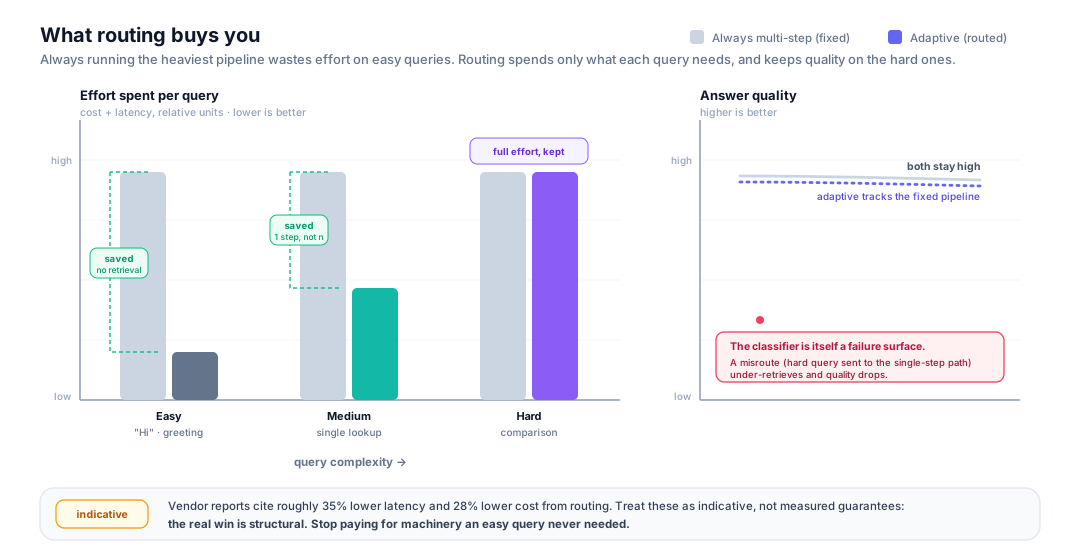
You will see numbers attached to this benefit, and I want to be careful with them. Some 2026 vendor write-ups of production routing deployments report on the order of 35 percent lower latency and 28 percent lower cost from adding a complexity router, sometimes alongside a small accuracy bump. Treat those figures as indicative, not measured guarantees. They are not from the Adaptive-RAG paper, which reports effectiveness and a step-count style of efficiency rather than a headline latency percentage, and they are not something I measured for you here. Your own numbers depend entirely on your traffic mix: route mostly greetings and trivia and you will save a great deal, route mostly genuinely hard comparisons and the classifier mostly just adds a step. The honest framing is that the win is structural rather than a fixed percentage. You stop spending on machinery an easy query never needed, and how much that saves you is something only your own traffic can tell you.
The caveat that matters most is that the classifier is itself a new failure surface. A fixed pipeline at least fails predictably: it always over- or under-serves in the same way. A router can misroute. The dangerous direction is under-classification: a genuinely hard, multi-part query that the classifier reads as single gets one retrieval where it needed several, under-retrieves, and answers a comparison from half the evidence. That failure is quiet, because the system confidently returns a fluent answer that happens to be missing a side. The opposite mistake, sending an easy query to the multi-step path, only wastes effort and is far more forgiving. So when you tune a router, tune it knowing the asymmetry: an over-served easy query costs you money, but an under-served hard query costs you a wrong answer. Add the router only once you can measure that tradeoff, which is exactly the discipline Part 11 was about.
💡 From experience. The first time I shipped a router like this, I made the classic mistake: I tuned it to be aggressive about the cheap routes, because the cost dashboard was the thing my manager was looking at, and sending more traffic to no-retrieval and single-step made that number drop beautifully. It looked like a win for two weeks. Then a support lead forwarded me a transcript where a customer had asked something like “what is the difference between your refund window and your warranty, and which one covers water damage?” and the bot had answered only about the refund window, fluently and confidently, never mentioning the warranty at all. My aggressive thresholds had read that as a single-step query and given it one lookup. The chunk it retrieved was real and correct, so nothing looked broken in the logs, and the answer was grounded in a true document. It was just answering half the question. The fix was not a smarter model. It was moving the threshold so that any query carrying a comparison signal or a second question mark fell to the multi route, and accepting that I would now sometimes run the expensive path on a query that did not strictly need it. I traded a little cost back for a lot fewer silently-half-answered questions, and that was the right trade every time. The lesson stuck: a misroute toward “cheaper” is invisible in your cost graph and very visible to the one user it failed.
Try it yourself
The router is small enough that you can feel every decision by editing one file. Grab adaptive_rag.py (numpy only, with an optional sentence-transformers path behind the usual offline guard) and run it. You will see the six demo queries split two to a class, exactly as the prose describes: the greetings take the none route and touch the index zero times, the refund and E-4042 questions take single with one retrieval each, and the two comparison queries take multi and fan out into two sub-queries apiece. Then try these three exercises, in order.
First, watch the asymmetry. Take the second multi demo, “What is the difference between the refund window and the warranty period?”, and delete its single question mark so it reads as a statement: “What is the difference between the refund window and the warranty period”. The phrase “difference between” is still a multi-signal, so it stays on multi. Now also rename that phrase to something the classifier does not key on, say “how the refund window compares to the warranty period” without the word “compare” (write it as “the refund window relative to the warranty period”). Suddenly nothing trips a multi-signal, the question-mark count is zero, and the query falls through to single. Run it: you get one retrieval, the answer is grounded in the refund chunk alone, and the warranty side is silently missing. That is the half-answer failure mode from the “From experience” note, reproduced in three lines. Notice how nothing in the output looks broken: the chunk it retrieved is real and correct, the answer is fluent, and only a human who knew there were two sides would catch it.
Second, mis-tune a threshold on purpose. The classifier has no numeric threshold to slide, but it has the moral equivalent: the multi_signals tuple and the q.count("?") > 1 test. Make the router aggressive about the cheap route the way a cost dashboard would tempt you to: change that test to q.count("?") > 2 (so two question marks no longer escalate) and drop "difference between" from multi_signals. Re-run the demos. The second comparison query now routes to single and under-retrieves, while the cost-per-query line in the figure drops beautifully. This is the exact trade the essay warns against: you bought a lower cost number by quietly making hard queries answer half of themselves. Then put both back and confirm all six routes return to matching the prose (the bottom line of the script prints all six routes match the prose: True).
Third, add a fourth route. Real systems often need one the three-route menu does not cover: a query whose answer is not in the knowledge base at all and needs web search, the escalation Part 10 called source routing. Add a web branch to classify_complexity (for example, route to web when the query mentions a competitor, a price, or “latest”/“today”, none of which your static policy chunks can answer), and a matching arm in route that calls a stub web_search(query) instead of the local retrieve. The point is not the search itself, which you can leave mocked, but the shape: complexity routing and source routing now sit side by side, and you can see for yourself that they are orthogonal decisions, one asking how much to retrieve and the other asking from where.
⚠️ Common pitfalls
- Tuning to the cost graph. Aggressively widening the cheap routes (more traffic to
noneandsingle) makes the cost dashboard fall and looks like a win, but every misroute toward “cheaper” is a hard query answered with too little evidence. That failure is invisible in cost metrics and visible only to the user it failed. Tune for the asymmetry: an over-served easy query costs money, an under-served hard query costs a wrong answer.- Treating a lone “and” as a multi-signal. A bare “and” joins clauses far more often than it bundles tasks (“refunds and exchanges are handled by support” is one lookup). Keying the multi route on every “and” floods the expensive path. The classifier here keys on specific conjunction-of-tasks phrases (“and then”, “both”, “each of”), not on “and” alone; “and” is used later, inside decomposition, to split a query that already routed multi.
- Confusing the router with a query transform (Part 8). A transform changes what you search with and always assumes you will retrieve. The router decides whether and how much to retrieve at all. If your “adaptive” layer only rewrites queries and still runs one retrieval every time, you built a transform, not a router.
- Confusing complexity routing with source routing (Part 10). Picking which index a query hits (HR store vs code store vs web) is orthogonal to picking how much retrieval it needs. Building a source router and calling it adaptive leaves every query triggering the same amount of retrieval it always did.
- Shipping the router before you can measure it. A fixed pipeline fails predictably; a router introduces a new failure surface that fails silently in the dangerous direction. Add it only once you can measure the under-serve rate on hard queries, which is the Part 11 discipline.
Key takeaways
- Adaptive RAG classifies each query by complexity and routes it to the pipeline that fits, instead of running one fixed pipeline for everything. It is the answer to the problem that a single pipeline over-serves easy queries and under-serves hard ones.
- There are three routes: none (small talk or a fact the model already knows; skip the index entirely), single (the Part 6 retrieve-then-generate), and multi (the Part 10 decompose-retrieve-synthesize for comparisons and multi-part questions).
- The complexity classifier is a small, fast function from query text to a route label, built here from deterministic rules over cheap signals (length, comparative words, a few conjunction-of-tasks phrases like “and then” or “both”, question-mark count) and replaced in production by a small trained classifier. The mechanism is the same; only the accuracy of the boundary changes.
- Adaptive RAG is the conductor over Parts 6 to 10, not a new retrieval technique. Do not confuse it with Part 8 (which transforms what you search with) or Part 10’s source routing (which picks which index to search). Complexity routing asks the prior question: whether and how much to retrieve at all.
- The benefit is structural: stop paying for machinery an easy query never needed, keep the heavy machinery for the hard query that does. Vendor figures like roughly 35 percent lower latency and 28 percent lower cost are indicative, not measured; your real savings depend on your traffic mix.
- The classifier is a new failure surface, and the dangerous direction is under-classification: a hard query routed to single-step under-retrieves and silently answers half the question. Tune for that asymmetry, and add the router only once you can measure the tradeoff.
References
- Soyeong Jeong, Jinheon Baek, Sukmin Cho, Sung Ju Hwang, and Jong C. Park. “Adaptive-RAG: Learning to Adapt Retrieval-Augmented Large Language Models through Question Complexity.” NAACL 2024. arXiv:2403.14403. This is the paper the whole part is built on. It frames retrieval as a per-query choice and trains a small classifier to predict each question’s complexity, then dispatches to one of three strategies: no retrieval, a single retrieval, or iterative multi-step retrieval. The headline result is not a latency percentage but a balance: across open-domain QA benchmarks, the adaptive system “enhances the overall efficiency and accuracy” versus baselines by spending the right amount of retrieval per query. Its accuracy lands between the single-step and the iterative multi-step strategies while using fewer retrieval steps on average than the pure multi-step approach (on HotpotQA, for instance, the reported run averaged roughly 1.6 steps against the iterative baseline’s roughly 2.1). That step-count style of efficiency, not a fixed cost-saving number, is what the paper actually claims, which is why the figures in this part are flagged as indicative vendor reports rather than measured guarantees.
Glossary
- Adaptive RAG: a RAG system that classifies each incoming query by complexity and routes it to the retrieval strategy that fits, rather than running one fixed pipeline for every query.
- Complexity classifier: a small, fast function that maps a query to a route label (none, single, or multi) from cheap signals such as length, comparative words, specific conjunction-of-tasks phrases like “and then” / “both” / “each of”, and question-mark count (a bare “and” does not trigger multi on its own); a rule block here, a small trained model in production.
- Router: the dispatcher that calls the complexity classifier and then invokes the matching pipeline (a direct answer, a single retrieve-then-generate, or a multi-step decompose-retrieve-synthesize).
- No-retrieval route: the path for small talk or a fact the model already knows, answered directly without touching the index; the cheapest route.
- Single-step route: the Part 6 retrieve-augment-generate loop, used for plain factual lookups that one retrieval can answer.
- Multi-step route: the Part 10 decompose-retrieve-synthesize shape, used for comparisons and multi-part questions that no single retrieval can answer.
- Complexity routing: routing a query by how hard it is to answer (how much retrieval it needs), as distinct from source routing, which picks which index or store the query should be sent to.
- Misroute: a classifier error that sends a query down the wrong path; under-classification (a hard query sent to single-step) is the costly direction because it under-retrieves and answers part of the question while looking correct.
That closes the Frontier Track. Across these three optional parts we extended the core series with token-level matching, contextualized chunking, and now per-query routing, all built by hand and all sitting on top of what you already knew. The series continues in Part 16, RAG vs Long Context, where retrieval meets its loudest challenger, the million-token context window. So this is a hand-off rather than a farewell: you now have the conductor as well as the instruments. Go point it at a real corpus, measure it the way Part 11 taught, and build something.